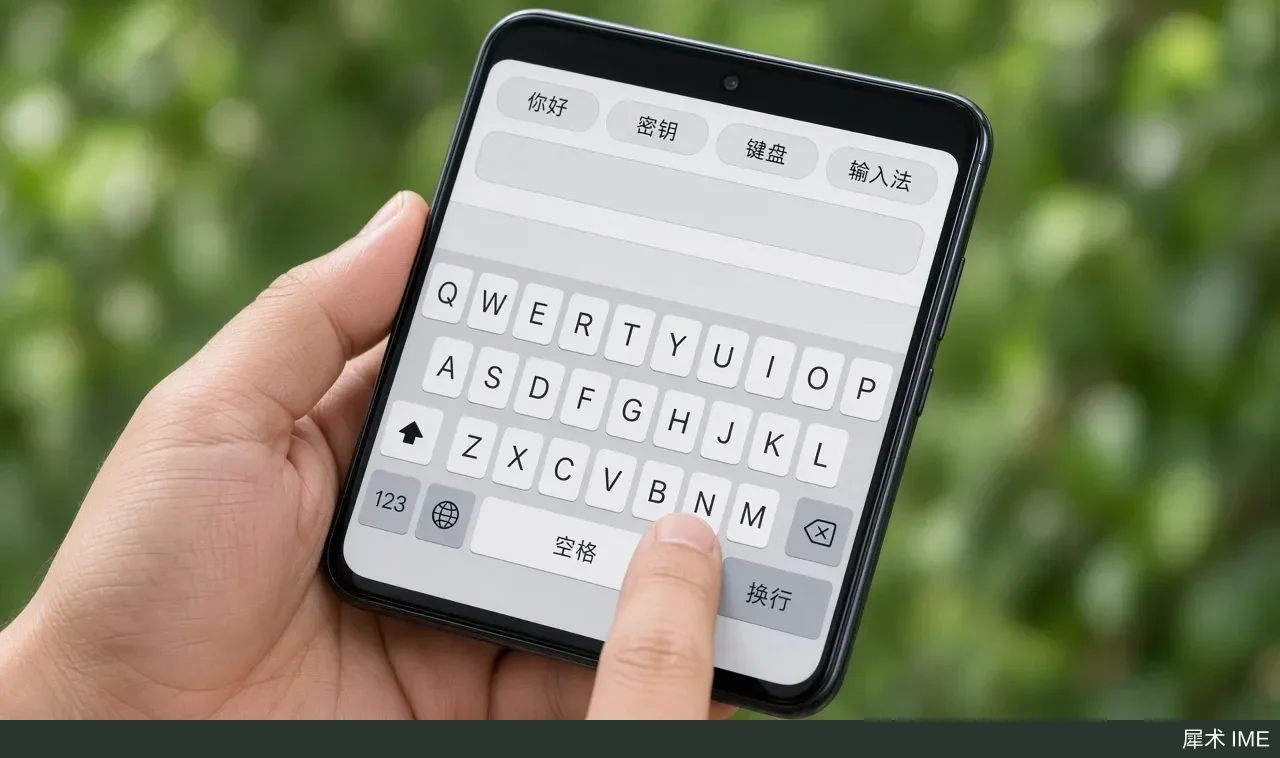
Typing Chinese on a full keyboard in a chat field, with candidates lined up above the keyboard. AI-generated schematic, not a screenshot of the actual Xishu IME interface.
1.1.8 had just shipped on every platform when the iOS build needed a new version because of an AI-key save error. On the evening of 23 October Beijing time, the repo merged three PRs in sequence: fix the -34018 error when saving AI configuration, bump iOS alone to 1.1.9, then fold pending candidate-bar, key-style, and Orthogonal-keyboard work into build 66. It is now waiting for review on the App Store and external TestFlight; other platforms remain on 1.1.8.
AI key save error -34018
If you see OSStatus error -34018 when saving AI configuration in the iOS main app, the problem is in packaging, not the key itself. Xishu’s main app and keyboard extension read and write API keys through the same Keychain shared group. On an unsigned archive, the build system expanded AppIdentifierPrefix inside the group name to an empty string, so the group name written into the runtime config lacked the prefix; cloud signing then authorized the full prefixed group name, while runtime still requested the unprefixed name, and the system refused with -34018. Analogy: the access card is registered for “Building 3, room 502,” but you swipe as “502”—of course you do not get in.
#276[1] gathers the full shared group name into one build setting; Info.plist and entitlements both take the value from there and no longer depend on prefix expansion at archive time. It also strengthens checks on unsigned archives and the final IPA, recording and comparing the runtime group name with the one the signature authorizes. The group name itself did not change, and no Keychain data migration was introduced; this PR also did not bump the version number. Per the 1.1.9 release notes, after the fix, shared access to already-stored API keys by the main app and keyboard is restored. For verification, Keychain store/retrieve round-trip tests in iOS CI passed; the PR also notes that on-device acceptance is still pending, and the build-66 preparation record states that CI pass is not on-device acceptance.
Candidate bar and key feel
After build 65 was uploaded, the maintainer found it had missed eight keyboard commits from a pending branch. #278[3] merged that batch as-is, so 1.1.9 is more than a hotfix—typing feel changes too.
Candidate bar
- Removed the hold-and-slide-to-select gesture on the candidate strip. The commit notes said it slowed scrolling and made touch feel laggy; tap and expand are unaffected.
- Pressing a candidate now uses a gray background instead of turning the whole chip blue; the press moment no longer triggers haptics or key sound, so sliding the candidate strip is quiet, and only a light selection feedback fires when a word is chosen.
- Adjacent candidates’ hit regions meet end to end, so a tap between two words always lands on one of them; a drag that starts in the gap between words can also scroll the candidate area.
- The expand/collapse button is 44 pt wide; after expand, rows below the first fill the full width, with no empty column on the right.
Keys
- Keyboard appearance settings add a key style, with Auto, Flat, and Legacy in the commits (Chinese release notes call them “flat” and “classic”); default is flat. Classic draws gray function keys, a 1 pt key floor, and an opaque container, to fit apps built on older SDKs; the keyboard extension cannot tell which app it is in, so Auto also draws as flat.
- Flat keys are drawn at 78% opacity so the translucent keyboard background shows through; the standard key block shifts down 2 pt overall.
- The number page follows the iOS 26.5 system keyboard: digits at 23 pt; single-character punctuation shrunk to 21 pt and centered on the glyph’s own ink; 123/ABC, #+=, Return, and Space labels at 15, 13, 16, and 16 pt. On number and symbol pages, the punctuation row fills the space between the side function keys.
Orthogonal keyboard becomes an independent layout
The largest structural change this version: chord input is no longer an input schema. “Orthogonal” sits alongside QWERTY and nine-key as a key layout, chosen separately from the input schema. The schema menu no longer lists chord; the keyboard’s layout menu and the main app’s layout picker gain “Orthogonal.”
| Input schema | Input method on Orthogonal layout |
|---|---|
| Full pinyin, Ziranma | Chord supported; chord codes follow the chosen schema |
| Wubi, imported schemas, and other schemas | Tap key by key; chord tables for Wubi and imports are left for later |
Settings already saved as a “chord” schema migrate automatically to the matching encoding schema plus Orthogonal layout. For example, full-pinyin chord becomes “full pinyin + Orthogonal layout” after upgrade—the typing method is unchanged; only where it sits in settings moves. The repo added tests for Orthogonal under each schema and for migrating old settings.
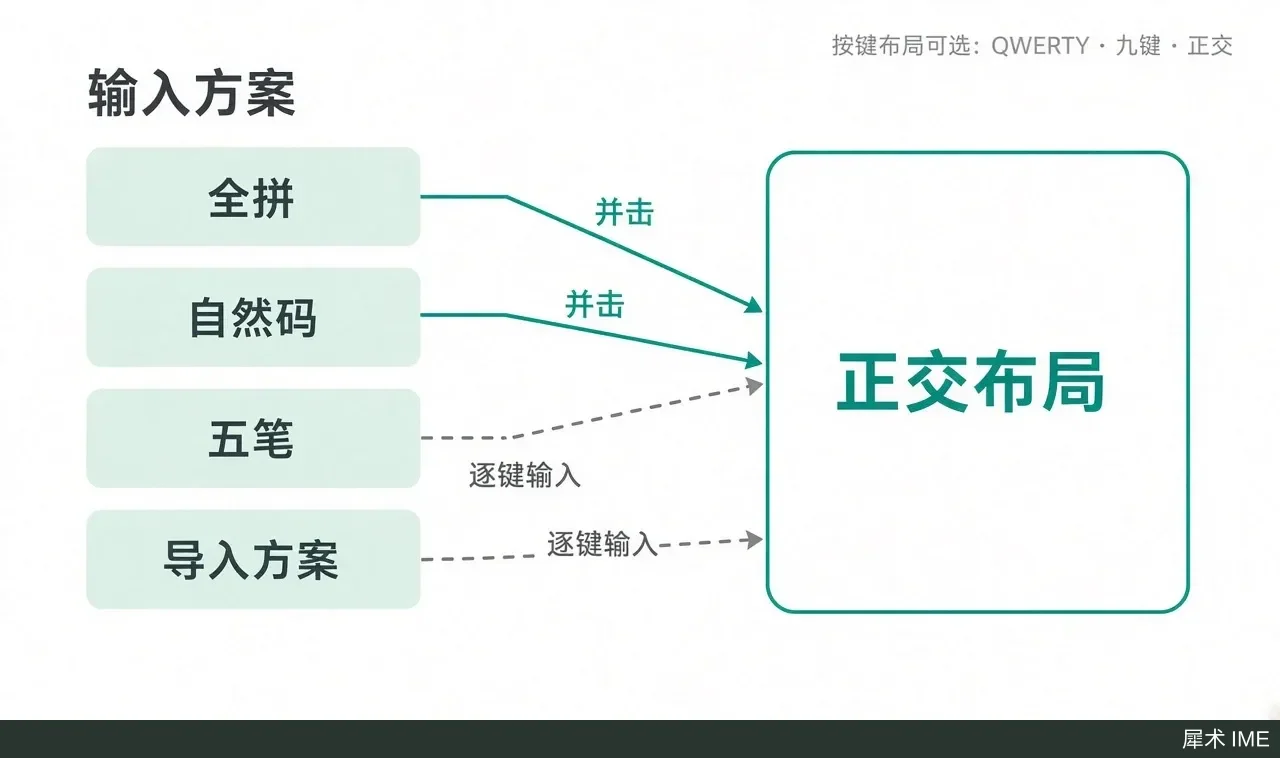
From 1.1.9, input schema and key layout are chosen separately: full pinyin and Ziranma can chord on Orthogonal; Wubi and imported schemas tap key by key. AI-generated schematic.
Review progress, platform versions, and upgrade checks
The version number moved in two steps. App Store already had 1.1.8 (64) live, so a Keychain fix submission needed a new version; #277[2] therefore bumped only iOS to 1.1.9 (65), left other platforms on 1.1.8, and changed archive and Fastlane version checks to read the iOS project’s own version instead of the desktop VERSION file. Then #278 folded in the keyboard work and raised the build to 66.
Per #278’s record, the formal archive was based on post-merge main (b3d1826); the cloud-signed 1.1.9 (66) IPA passed version, signature, provisioning-profile, and shared-group checks, was uploaded and processed by Apple, and both App Store and external TestFlight submissions showed Waiting for Review. The build-65 submission was withdrawn and the store draft switched to 66. iOS PR and formal-archive CI together: 278 tests passed, 5 skipped by condition, 0 failed; a downstream Linux packaging job was canceled after exceeding the 45-minute limit downloading Ubuntu dependencies, so product tests never started. Review outcome is not yet in the public record; this article does not treat 1.1.9 as shipped.
As of writing, the latest formal GitHub tag is still v1.1.8 (released 08:09 Beijing time on 23 October). Platform status:
| Platform | Current version | Note |
|---|---|---|
| iOS · App Store / TestFlight | 1.1.9 (66) waiting for review | Until review passes, App Store still shows 1.1.8 (64) |
| iOS · community IPA | 1.1.8 (64) | GitHub release page has no 1.1.9 installer yet |
| macOS, Windows, Android, Linux | 1.1.8 | No separate release this round |
After review passes and you update to 1.1.9, you can confirm with the steps below (not yet run on a real device; results follow the version that actually ships):
- In the App Store confirm Xishu IME is 1.1.9; external TestFlight testers can check whether the build number is 66.
- Save AI configuration once more in the main app; no -34018 means shared Keychain is healthy again.
- In keyboard appearance settings, check key style—default is flat; if the keyboard clashes with some apps’ UI, try classic.
- Users who previously used chord: check that the schema became full pinyin or Ziranma and that key layout is Orthogonal.
References
-
scholay/xsime #276:fix(ios): preserve shared Keychain group through unsigned archives
-
scholay/xsime #277:fix(ios): prepare 1.1.9 Keychain repair for Apple distribution
-
scholay/xsime #278:fix(ios): include pending keyboard work in 1.1.9 (66)
-
Commit 6aff8ec:key style setting, symbol row fill, drop candidate hold-select
-
Commit bbb67b4:calmer candidate taps, no dead gaps, full-width expanded rows
-
Commit 97ec002:match Apple's number-page glyph sizes and mark positions
-
Commit 78eba4b:let drags that start in candidate gaps scroll the matrix
-
Commit 4866a8b:lower the key block 2 pt and let flat keys show the glass
-
Commit f08310d:make flat keys more translucent (78% opacity)
-
Commit 814ad6b:centre number-page marks by their ink and shrink them to 21 pt
-
Commit c52d380:make the orthogonal grid a layout any scheme can use
-
Xishu IME · When minds meet, craft appears in the writing
-
Information compiled and published by the Scholay academic one-stop platform; report infringement for takedown.
-
Also published on Enter Scholar, a scholars’ community for the intelligent age