Being able to type English letters in Rime and being able to pick words from English candidates are two different things. The former can hand keyboard characters straight to the editor; the latter lets the input schema supply selectable words. Two commits in rime-wubi add the English schema itself and its inter-word spacing feature, respectively. If one machine inserts spaces automatically and another glues two words together, the first thing worth checking is whether both are using this English candidate schema.[1][2]
Confirm which schema is selected first
The commit that adds a pure English schema puts english into the default schema list and ships the matching schema file and English dictionary. It sits alongside the existing Wubi 86, Wubi–Pinyin, and other schemas. Select the English schema in the schema menu, then switch it from direct input to candidate mode to use its dictionary and candidate pipeline. The schema initially resets to direct input (ascii_mode: 1), so selecting the schema alone is not enough. Switching an existing Wubi schema into direct letter input will still produce text on screen, but that path never attaches the English dictionary’s candidate filter to the input process.[1][2]
Spacing depends on the previous commit
The later commit adds an english_spacing switch to the English schema and lists a Lua filter of the same name in the schema. The two configuration states are spacing off and spacing on; this commit’s reset value is one (on). The filter reads the text of the most recent commit: if it ends with an English letter, the filter prepares to prepend a space to the next qualifying candidate. That check runs before the candidate is committed; it does not go back into the document to re-segment a full English sentence already written.[2]
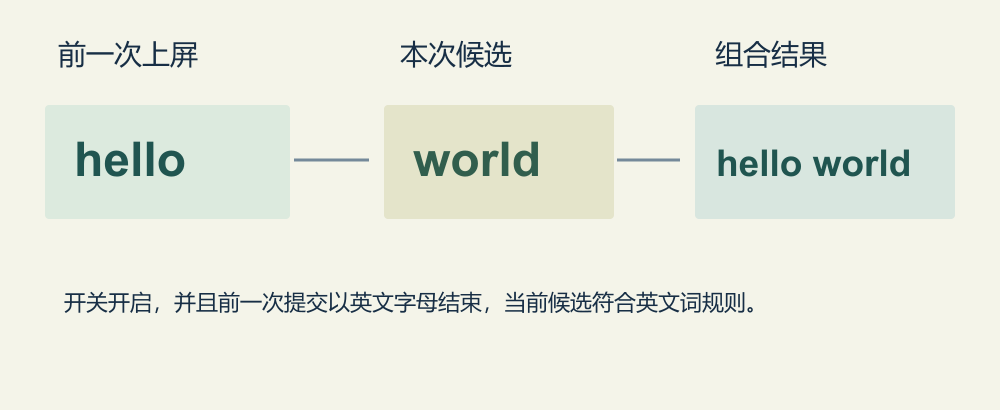
Figure: Inter-word spacing is decided by two successive inputs together.
Two words chosen in succession make this clearest. Commit hello first, then select world: the previous commit ends with a letter, and the current candidate also matches English-word form, so the result is hello world. If the previous commit already ended with a space, punctuation, or a digit, the first condition fails. What matters here is the most recent commit record; two words that look adjacent on the editor screen are not always the same thing. After switching away and moving the caret, do not treat this as a segmentation rule that can read the whole document.[2]
The candidate itself faces a further check. The code requires it to start with an English letter, with later characters limited to English letters or the English apostrophe. Contractions such as he'll pass; hyphenated compounds or items that start with a digit do not match this form. With the switch off, or on a direct-input path, neither of these conditions is applied to produce an automatic prefix. When diagnosing which step is wrong, try two ordinary English words first, then change only the final character of the previous word—that is easier to read than swapping the schema, dictionary, and client all at once.[2]