The next Xishu IME update will verify a signature manifest before it continues to download and install. The release hardening merged on 29 October stores the packages and the manifest as a draft first, checks that they are complete, and publishes them once. It also adds recovery and cancellation for the update tasks on each platform. These changes take effect in the next formal version. The package that is public now is still 1.2.0. No new version was put on the shelf this time.
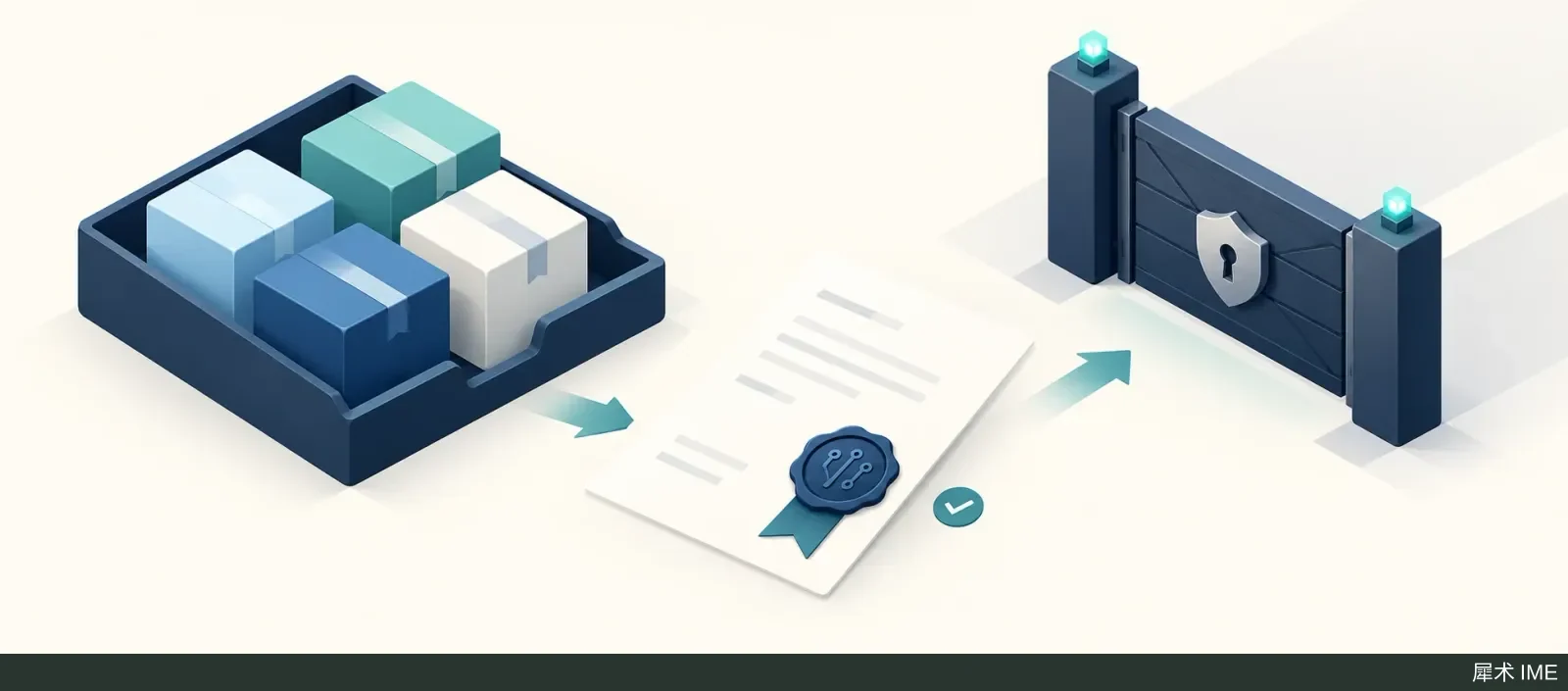
An AI-generated schematic: packages and a signature manifest wait in draft to be verified before they are made public. This is not a product interface.
Publishing and signature checks in the next version
This adjustment covers the release side and the update checks on macOS, Android, Windows, and Linux. The publish order of the next formal version is:
- Put the four platforms’ packages and the signature manifest into a draft from the same source.
- Read each item back and check it, and have the server re-check the five-platform CI for that exact commit SHA.
- Publish once after everything passes. Formal release and failure recovery share a mutual exclusion, which blocks Latest and the Android build number from moving backward.
The update manifest adds a separate P-256/SHA-256 signature, with a 90-day validity, and it supports a two-signature rotation. Clients on the four platforms check the original payload, the public key, the validity period, and the highest version already seen. An old client can still read the existing top-level fields. A new client will not fall back to accepting an unsigned manifest.
Take an interrupted release as an example. Recovery reuses the build artifacts and the signature manifest already verified in the original run. It does not sign them again, and it does not overwrite bytes that are already public. If the signature or the artifacts have expired, recovery fails explicitly and the next formal version continues the release. A package and a manifest that are already public cannot be replaced in place, so a current 1.2.0 user does not need to reinstall because of this code merge.
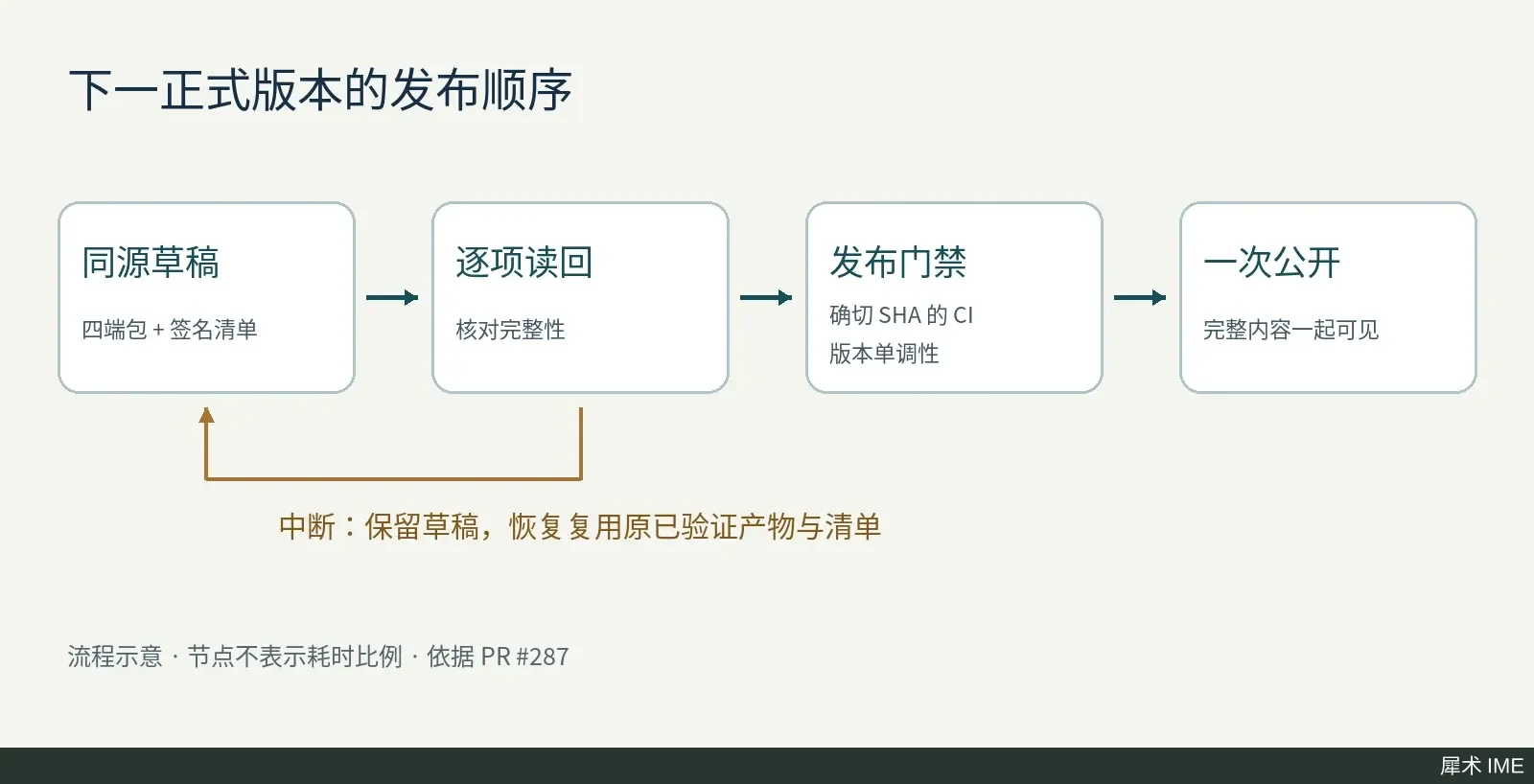
A release-flow schematic drawn for this article, following PR #287[1]. The nodes do not represent shares of time.
What changes in each platform’s install task
The checks before installation, and the way a task continues after download, move with the release path:
- macOS: check the minimum system and hardware requirements first, and check the signature and the digest again before installation.
- Android: an application-level task holds the download and the install state, handles cancel, retry, and page rebuild, and reads back the version that was actually installed, so page state does not stand in for the install result.
- iOS: use the actual Storefront, and handle the related information by the store region the user is in.
- Windows: keep a verified file fixed until installation starts, and put a cross-session mutex on the install root, so parallel installs do not interfere with each other.
- Linux: cancellation is possible before waiting for the lock, before transfer, and before elevation. After installation is handed to apt, the package-management transaction is not forced to stop.
This batch of changes keeps the identities of the input method, the package, the schema, and the user data. The Authenticode status of the Windows EXE also does not change because the update manifest gained a signature.
Repository cleanup and what was verified
At Beijing time on 29 October 2026, PR #287 was merged into main. The merge commit is c4228820, and the commit time is 2026-10-29T10:26:54Z. The product branch moved from the 1.2.0 documentation freeze point 140bc9eb to that commit. PR #286, merged the same day, supplies the basis of the repository cleanup: about 156.8 MiB of acceptance screenshots and logs were untracked, Markdown was gathered from 284 files to 112, and the current document entrance was concentrated at docs/README.md. That cleanup does not change the product version, the signature, or the package identity.
All six remote workflows this time — the main CI, Android, Windows, Linux, iOS, and the macOS release rehearsal — succeeded. The HEAD under test was a6cafee6 in each case. Among them, an Android debug package from the same source and with the same signature completed an upgrade across builds, which checked process replacement and the keeping of private files and settings. The object of that result is a debug upgrade across builds, not a migration of data from an old production version. Android local checks and CI also checked the original production certificate and the APK/AAB identity.
These results support the code and the release rehearsal having passed. They are not the same as the product having been released. By design, PR mode skips formal signing, the production signature manifest, and the public release steps. This time no new release tag was created, and no store upload was triggered. A complete draft release and the signature manifest will be used for the next formal version. Another pull request, #284, involving Linux GCC 16, nlohmann-json, and ICU, was still open. It is not counted in this merge.
References
- PR #287: harden signed updates, complete release, and install recovery
- PR #286: remove acceptance attachments and slim the project documents
- Merge commit c4228820
- Document entrance at this merge commit
- Formal release v1.2.0
- Remote CI: main CI, Android, Windows, Linux, iOS, macOS release rehearsal
- PR #284: Linux build-compatibility fix, still open
References
-
Compiled and published by Scholay. For a takedown request, send feedback.
-
Also published at Enter Scholar.