The 1.1.5 brand move for Xishu IME changes the name a user sees, the site entrance, and the repository rule the macOS updater recognizes. It deliberately keeps the install identity and the data paths. Behind the new name, what has to be updated, and what has to continue? The account below follows the repository documents. It was not tested on a machine. The release target and the actual public status are stated separately.

A dark-green rhinoceros in profile. The article states no separate license for this picture. The public copy includes a bottom “犀术 IME” strip.
How the product name and the repository got here
RIMES, Lingxi Input Method, and Lingxi IME are all names this project has used. The current README states “犀术IME / 犀術IME / XSIME” as the single name of the product, the project, and the architecture. It also warns that names already published in clients, stores, and filings still update by their own processes, and that this does not mean every one of them has already changed. The project’s old name, RIMES, should also be kept apart from the upstream RIME input-method engine it uses.
The repository address and the name shown on the product are two trails that have to be read separately. The 1.1.5 release notes list both the official scholay/rimes and scholay/xsime addresses, and they say that after the repository was renamed the old web page and Git address continue to be redirected by GitHub, and that the old repository name is not taken again. Seeing rimes in an old link or a compatibility path does not mean it is another product. The readable material now available is not enough to reconstruct, step by step, the dates and the order of the product and repository renames. Those details still have to be checked against the original text of BRANDING.md, RELEASE-HISTORY.md, and CHANGELOG.md.
What 1.1.5 changes in the brand
The 1.1.5 release notes set the simplified-Chinese display name as “犀术IME,” the traditional-Chinese name as “犀術IME,” and the English name as “XSIME.” The site is unified at xsime.com. Install information for macOS, Android, and Windows, and the Linux package metadata, use that entrance. The iOS 1.1.5 (59) binary already submitted for review stays frozen. The site inside the app is still the old address, and the plan is to update it in the next iOS build.
The documents record the target version and the public-release status separately. A build that passes is not the same as a store review that passes, or a real desktop check that is finished. It cannot be taken to mean that every platform has already been released to the public.
The identity that stays compatible, and what the update covers
The move keeps the Bundle ID, the applicationId, the Windows CLSID and registry identity, the Linux package name fcitx5-rimes, and the existing install-file names and user-data paths. Old help and privacy-page addresses, and the upstream names and license information for Rime and librime, are also kept. By the upgrade design in the release notes, a user does not have to uninstall first or clear the dictionary. This article did not verify that on a machine.
The macOS updater queries a fixed GitHub repository ID. It accepts only the official scholay/rimes and scholay/xsime addresses, and it still checks the asset, the signature, and the package identity. An old updater may reject the redirect that follows a repository rename. The documents suggest that, after 1.1.5 is formally released, a new PKG be downloaded once by hand from the official Releases and installed, keeping ~/Library/RIMES. Old web and Git addresses continue to be redirected by GitHub. The old repository name is not taken again.
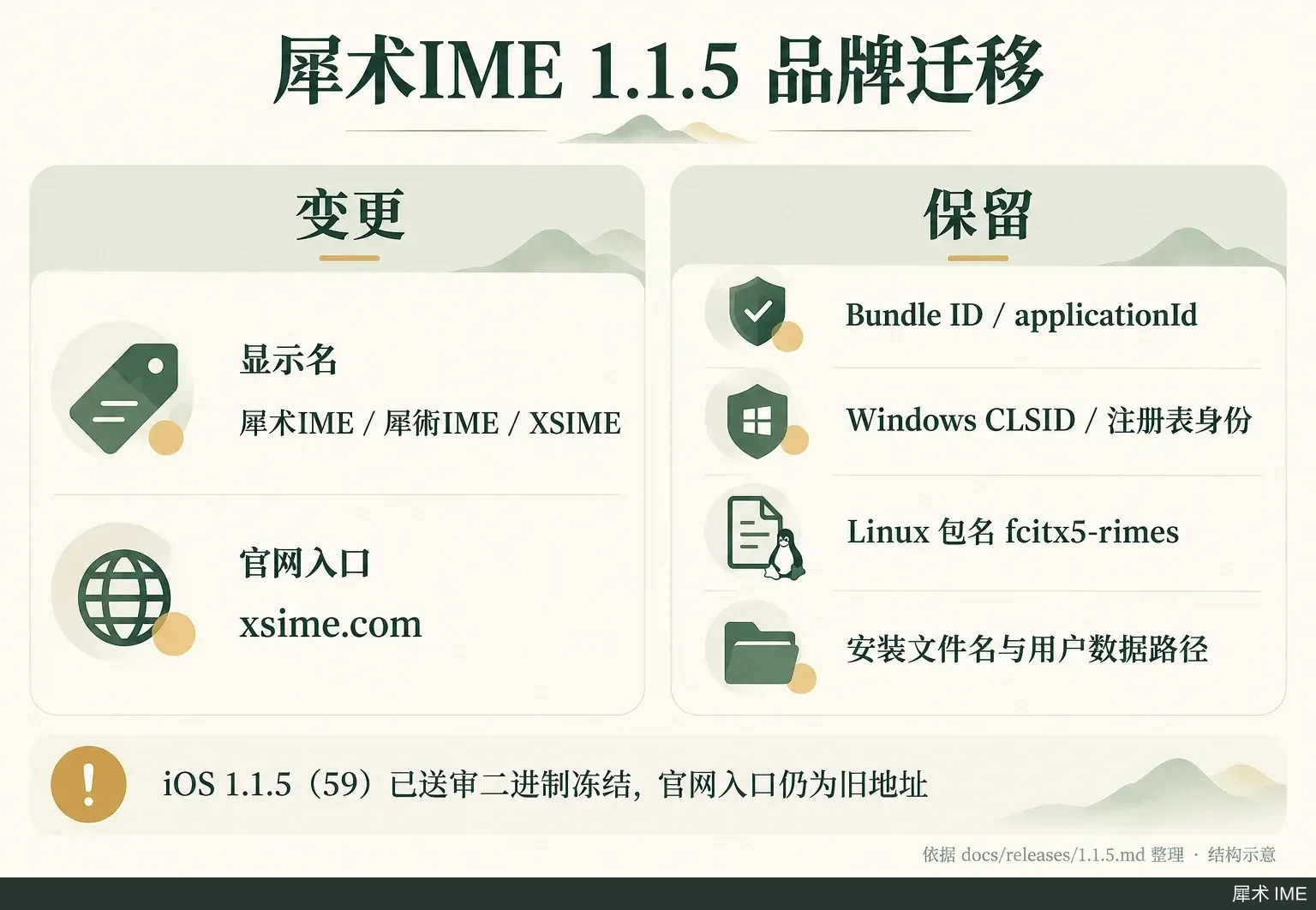
A comparison of what the name and the site change, and what the install identity and the data paths keep. An iOS exception is noted at the bottom. The article states no separate license for this diagram. The public copy includes a bottom “犀术 IME” strip.
References
- Xishu IME / XSIME 1.1.5 release notes (mounted snapshot 7ef780d, lines 1–34).
Still to be read: the original text of BRANDING.md, RELEASE-HISTORY.md, and CHANGELOG.md.
References
-
Compiled and published by Scholay. For a takedown request, send feedback.
-
Also published at Enter Scholar.